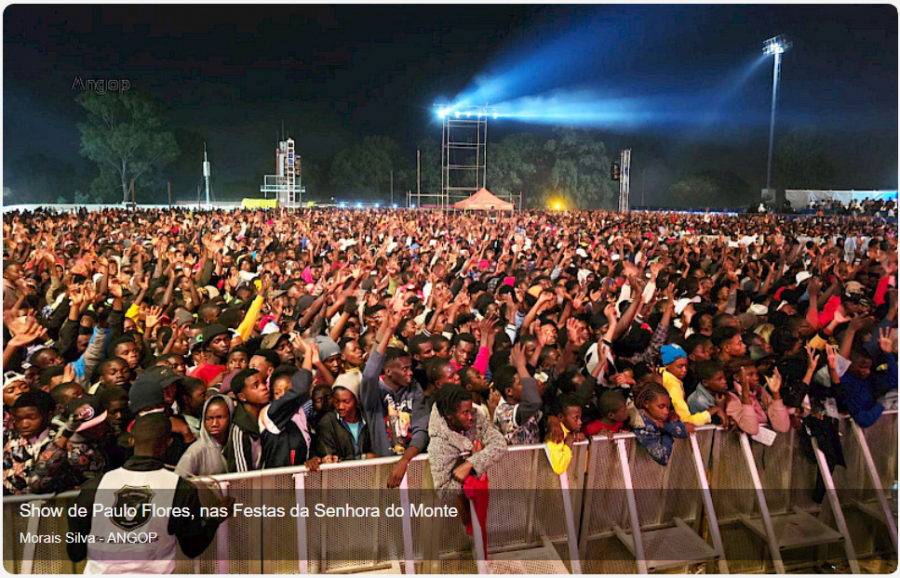
When making a provisional assessment, in statements to ANGOP, the president of the Festivities Committee, Paulo Gaspar, considered the participation of national and foreign tourists in the activities carried out to be positive, as well as the fulfillment of 85 percent of the scheduled activities. Highlights included Expo-Huíla, the Cattle Fair, the Miss Huíla 2024 contest, the Paulo Flores show, Moda Mwila and the 200 kms of Huíla.
The budget limitation, according to the Grêmio member, was the main constraint, as out of the forecast of 105 million kwanzas, only 43 million were achieved.
In general, he said, the Nossa Senhora do Monte festivities reached 85 percent of the scheduled events, some had to be suppressed due to budget problems.
For 2025, Paulo Gaspar predicts the mobilization of a budget that is capable of supporting the costs of the event that is 122 years old, through a diagnosis that is already underway, given that it coincides with half a century of national independence.
The Festas de Nossa Senhora do Monte began to be celebrated in 1901, a replica of those in Madeira, Portugal, the land of the settlers who based themselves in the region.
On August 15, 1902, with the chapel still under construction, the parish priest celebrated open mass on the terrace, in front of an image of Our Lady of Conception, taken from the parish.
Once the construction of the chapel was completed, with the image of Nossa Senhora do Monte, acquired in Porto (Portugal), it was installed on the altar and blessed on August 14, 1903 by Father José Martins, representing the Bishop of Angola and Congo.
Historical sources indicate that the construction of the chapel was marked by two distinct phases over time, the first of which began with the construction of the primitive chapel, guided by the bricklayer Jacinto Rodrigues and the carpenter João da Silva, in 1902.
The first open mass was celebrated on August 15, 1902, with the chapel still under construction. From the following year (1903), the population of Lubango began going to the chapel to celebrate the pilgrimage that became traditional, but the work only ended in 1921. JT/MS
 English
 Português