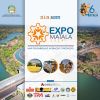
At the official opening ceremony of the festivities, the municipal administrator, Manuel Machado Quilende, asked for the participation of all local forces and the support of local businesspeople in carrying out the most pressing development tasks socioeconomic status of the municipality.
He stated that this is an event that concerns all residents, so discipline and commitment must be part of the character of the citizens during the festivities and beyond.
The director of the administration's Communication office, Imaculada Sabonete, the program foresees the realization of the scholarship local business (Expo-Matala), a workshop on inheritance within the family, as well as a round table on the current state and development perspectives of the municipality.
Men's and women's athletics, courtesy visit to Embala Cauvi, a cultural musician show, meeting with producers of the Cwam cooperative and cleaning campaign fill the anniversary's agenda, according to the director.
Historical-geographical portrait The municipality of Matala is one of the most important in the province of Huíla, as it is the second most populated, after Lubango, with an estimated population of more than 360 thousand inhabitants.
In addition to boosting the economy, given that it has the largest irrigated perimeter in the country with a 42-kilometer canal, it The main hydroelectric plant that supplies Huíla and Namibe has been installed.
Given that the south of Cunene was under constant South African foreign invasion and occupation, between 1981 and 1989 the city of Matala was temporarily its capital.
It is limited to the north by the municipality of Chicomba, to the east by the municipalities of Jamba and Cuvelai (Cunene), to the south by the municipalities of Ombandja and Cahama (Cunene) and to the west by the municipalities of Gambos, Quipungo and Caluquembe.
The main commune, corresponding to the city of Matala, and Capelongo, Micosse and Mulondo are part of it. Being a municipality in a convergence zone of various ethnicities and peoples, the language used is Portuguese, with a reasonable size among the native ones, nyaneka, umbundu, gangela, hemba, cuanhama and cokwé. MS
https://angop.ao/noticias/sociedade/abertas- festivities-of-the-66-years-of-matala/
Available daily from 08:00 to 22:00. This support line helps clarify doubts, assist with reservations and guide you towards the best accommodation and tourism services.
 English
 Português




 WhatsApp
 Phone
Phone
 Email
Email